Term Correspondence and Origins Between Unity and Unreal Engine: Why Are They Called Blueprint and Actor?
This article is a translated version of my original post on Qiita. Original (Japanese): https://qiita.com/segur/items/19d7fe63c1fa93af198f
Introduction
Recently, I posted an article titled 10 Years with Unity: My Confusion When Learning Unreal Engine, and I was grateful to receive a lot of feedback. Among the responses, a prominent theme was the confusion over differences in terminology between Unreal Engine (UE) and Unity. After posting a related comment on X, I received even more unexpected feedback and many shared similar concerns.
https://x.com/segur_vita/status/1916357137413943333
With this in mind, this article aims to create a correspondence table for Unreal Engine terminology from the perspective of a Unity engineer and further delve into the origins and backgrounds of these terms.
I previously wrote an article titled Exploring the Origins of Unity Terminologies, and this time, it's essentially the “Unreal Engine version.”
Rather than just a "synonym table," I would like to trace the "why these names" aspect to get closer to the intentions and philosophies behind Unreal Engine's design.
Unity ⇄ Unreal Engine Term Correspondence Table
First, I organized the main corresponding terms in Unity and Unreal Engine into a list. Even when terms seem similar at first glance, there are often significant differences in the underlying design philosophies and usage, so I've also included brief notes.
| Unity Term | Unreal Engine Term | Summary of Differences |
|---|---|---|
Scene |
Level |
Both refer to a "space" where objects are placed, suggesting similar functionality. |
Prefab |
Blueprint |
Prefabs are collections of GameObjects and Components, while Blueprints consist of Blueprint Classes and Components, sharing reuse concepts. |
GameObject |
Actor |
Both are basic units placed in 3D space with Transforms. |
Component |
Component |
Though similar in name and role, UE's components are treated as part of a hierarchy with structural differences. |
Rigidbody |
Physics Body |
Elements concerning physical behavior. |
Collider |
Collision |
Functions for collision detection. |
C# |
C++ |
Both are text-based programming languages, but C# is often considered more approachable. |
Visual Scripting |
Blueprint EventGraph |
Both offer node-based scripting, but Blueprint's deeper game integration provides an advanced mechanism. |
Warning: This table is a conceptual-level comparison from a Unity engineer’s perspective. It is not a strict one-to-one correspondence, and should be used as an aid in understanding.
Some of you may think "There are other terms!" However, I have primarily focused on the ones I was personally confused by and researched.
During my investigation, I discovered that the official Unreal Engine already provides a Unity-to-Unreal Engine Transition Guide (terminology correspondence table)!
https://dev.epicgames.com/documentation/ja-jp/unreal-engine/unity-to-unreal-engine-overview
......In this article, I will delve deeper into the etymology and differences in design philosophy.
Origins and Backgrounds of Scene/Level
Unity: Scene
In Unity, a Scene functions as a single "stage" or "scene" within the game. This term directly comes from the English scene (=a stage's act) and is used similarly to "scenes" in theater or film as a visual and structural unit.
In Unity, objects are placed within individual Scenes, and gameplay typically progresses by switching between multiple Scenes. Many are likely familiar with the term "scene transition."
Unreal Engine: Level
Conversely, in Unreal Engine, this equivalent concept is referred to as a Level.
The term originates from the Old French word livel, referring to a "leveling instrument" in construction. This evolved into the meaning of "horizontal" in English around the 14th century, and further into "stage" or "grade."
This term was adopted into 1970s tabletop RPGs (TRPGs) as a word for "dungeon layers" or "character progression stages." It was then inherited by the video game culture of the 1980s, eventually making its way into Unreal Engine.
graph TD
    livel("【Old French】livel<br>leveling instrument")
    horizontal("【14th-century English】level<br>horizontal")
    degree("【15th-century】level<br>stage/grade")

    dungeon_level("【TRPG】level<br>dungeon layer")
    character_level("【TRPG】level<br>character growth stage")

    map_stage("【Action Games】level<br>map/stage")
    rpg_level("【RPG】level<br>character growth degree")

    unreal_level("【Unreal Engine】level<br>game space")

    livel --> horizontal
    horizontal --> degree
    degree --> dungeon_level
    degree --> character_level
    dungeon_level --> map_stage
    character_level --> rpg_level
    map_stage --> unreal_level
Incidentally, the system that coined the term "level" as a measure of character growth in terms of experience points accrued—enhancing HP and offense—was the 1974 tabletop RPG Dungeons & Dragons (D&D).
Notably, both level as "map" and as "growth degree" roots in tabletop RPGs! The now-common gaming terminology spreading from the analog game culture of those times is fascinating.
Origins and Backgrounds of Prefab/Blueprint
Unity: Prefab
In Unity, a Prefab represents a "template for reusable objects." It allows multiple GameObjects and Components to be saved as a single unit for replication and reuse elsewhere.
Its origin is from the English term pre-fabricated; i.e., something "pre-assembled." In architecture, this referred to constructing components in a factory for on-site installation.
Prefab indeed matches its meaning: a system for “reusing a predesigned structure” where required, exemplifying Unity's simplicity and high versatility.
Unreal Engine: Blueprint
In Unreal Engine, the equivalent system to Prefab is called Blueprint (more precisely, Blueprint Class).
However, Blueprint feels more like defining appearance, structure, and logic in one, an aspect suggested by blueprint meaning "design plan."
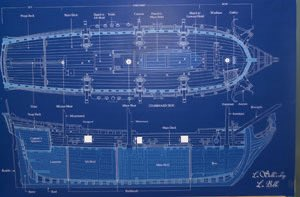
Why does blueprint mean "design plan"? It seems this stems from a 19th-century copying technique known as "blueprints". This predecessor to modern copy machines used special photosensitive paper, turning white parts blue and black lines white.
Extensively used in architectural design, it established the term blueprint = design plan in English.
 |
|---|
| Blueprint photo Image source: Wikipedia "Blueprint" |
Thus, the Unreal Engine's Blueprint was named as a "design method" rather than a "means of implementation."
Origins and Backgrounds of GameObject/Actor
Unity: GameObject
In Unity, a GameObject is the basic unit in a scene. It can be a 3D model, UI, camera, light, or an empty object. All exist as GameObjects with Transform for spatial placement.
As suggested by its name, it indicates any object within a game, an intuitive and highly generic name.
However, its functions are extended by Components, making GameObjects akin to containers on their own.
Unreal Engine: Actor
In Unreal Engine, Actor corresponds to this concept. With Transform, Actors are spatial units within a level.
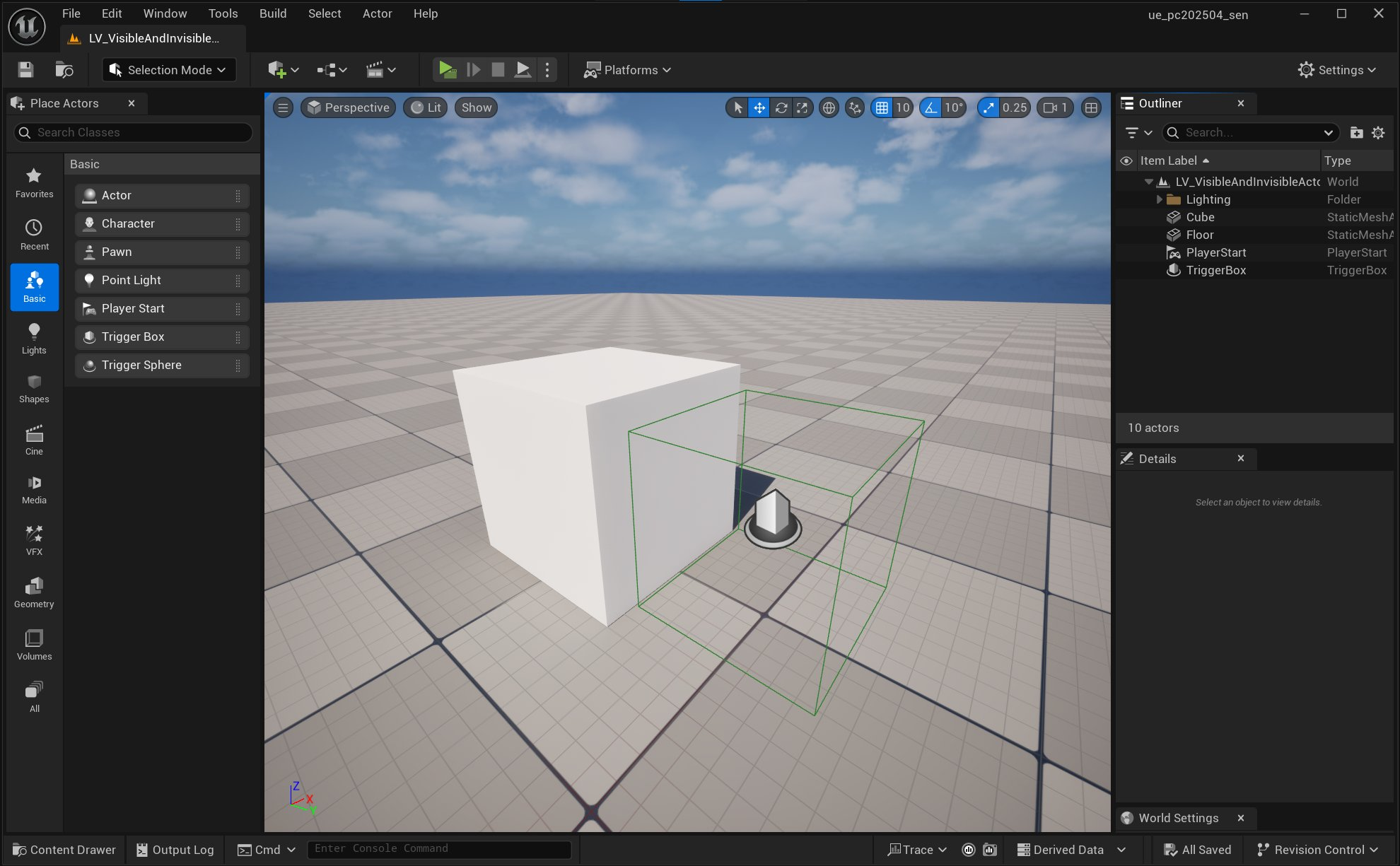
While dictionaries define "Actor" as an "actor," Unreal Engine extends this term to cover both visible and hidden game logic or triggers, such as invisible objects like Trigger Volumes for triggering events upon entry.
The English word actor also connotes an entity with a role on the stage, apart from simply an "actor." Thus, Unreal Engine's Actor refers to any entity with behavior or a role in the game world, visible or not.
This embodies a nomenclature sense akin to Unity's MonoBehaviour, although functionally closer to Unity's GameObject.
 |
|---|
| Illustration of a visible Cube and an invisible Volume. Both are Actors. |
Bonus: What Does "Unreal" in Unreal Engine Mean?
I also looked into the origins of the name "Unreal Engine." It's actually rooted in the 1998 FPS game Unreal by Epic Games (then Epic MegaGames)!
This game gained fame for its stunning graphics and became a massive hit in the Western world. The toolset developed in-house to create this game eventually became known as "Unreal Engine."
 |
|---|
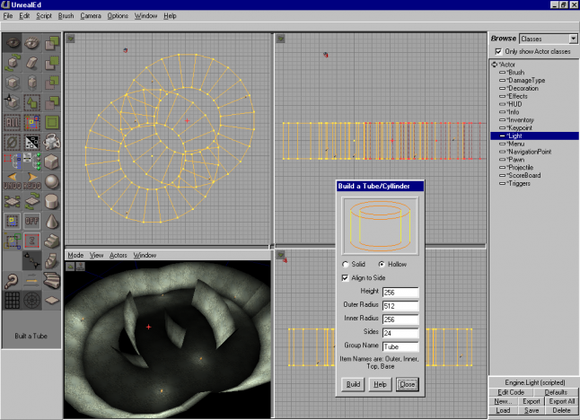
| UnrealEd (Unreal Editor) UI around 1998. Image source: Game Developer interview with Tim Sweeney https://www.gamedeveloper.com/design/classic-tools-retrospective-tim-sweeney-on-the-first-version-of-the-unreal-editor |
Interestingly, the early Unreal Editor (nicknamed UnrealEd) was made using Visual Basic UI. "Creating an editor to make games" — this passion seems to have carried over into Unreal Engine's current philosophy.
Summary
Though both Unreal Engine and Unity are superb game engines, their differences in terminology and design philosophy can be confusing initially. I myself faced significant confusion over UE-specific terms like Actor and Blueprint.
Thus, in this article, I organized a term correspondence table from the perspective of a Unity engineer and focused on the origins and backgrounds of these terms!
By reconsidering terms from the perspective of "why are they named this way?", I hope to provide helpful hints that lead to a more fundamental understanding!
In Conclusion
I drew from the following resources in creating this article. Thank you for the useful insights.
- https://en.wiktionary.org/wiki/level
- https://www.reddit.com/r/etymology/comments/8ornsv/what_is_the_origin_of_level_to_denote_an_area_in/
- https://en.wikipedia.org/wiki/Dungeons_&_Dragons
- https://ja.wikipedia.org/wiki/青図
- https://www.reddit.com/r/unrealengine/comments/1b7k90k/why_actor_for_class_name/
- https://www.gamedeveloper.com/design/tips-for-building-game-dev-tools-and-ux-from-ubisoft-s-david-lightbown